Compare garage door quotes without losing the scope or counting a fee twice
Worked methods and examples from Relay. References checked November 13, 2026.
A repair price and a door-package price may describe very different work. First make each scope complete, then compare the customer’s remaining payment and total outlay. Keep the diagnosis separate from the arithmetic.
Normalize what each quote includes
For the repair, name the diagnosed defect and the work proposed to address it. For replacement, identify the door package, matched hardware and track, opener inclusion, removal and disposal, installation, testing and any restoration or permit allowance. Record what is included and excluded; a cheaper package that omits required work is not the same offer.
The FTC advises comparing written estimates that identify the work, materials, price and completion date. Use actual contractor quotes rather than a national average or a search result. Add separately priced opener or removal work only if it is missing from the package. Adding an included item a second time makes the comparison wrong.
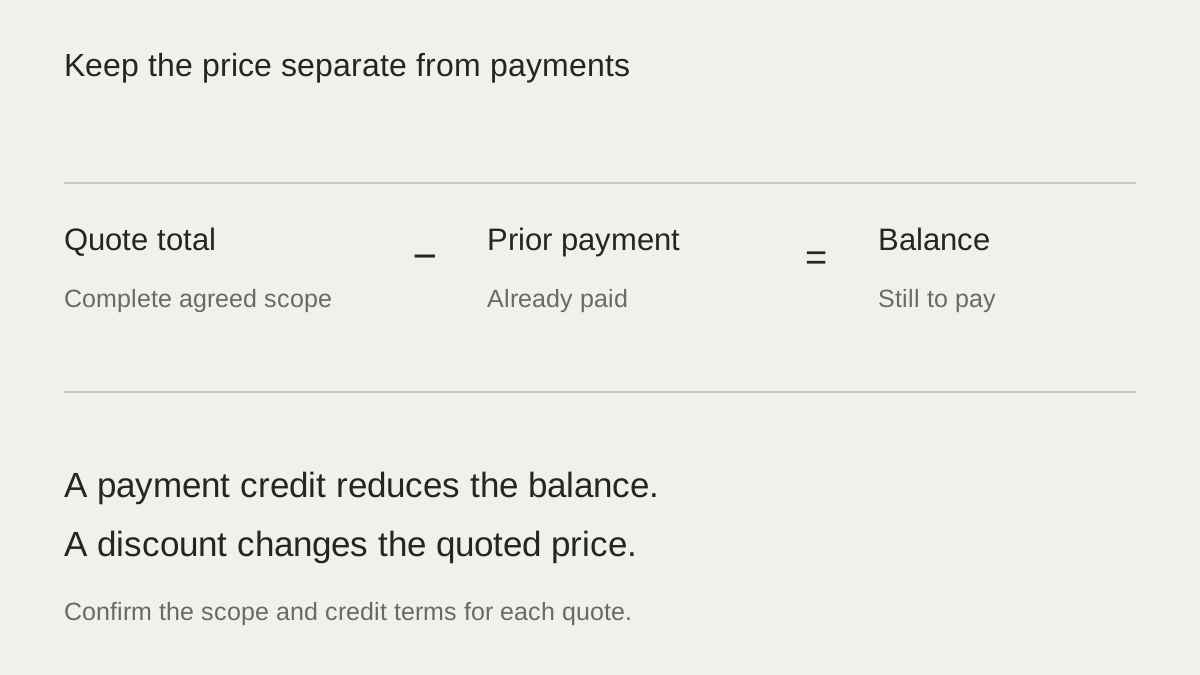
An already-paid fee is a payment, not a new discount
Suppose repair is quoted at $450. Replacement includes a $2,500 installed door package, a separately quoted $450 opener and $150 of removal or other excluded work: $3,100 before any entered tax. The customer has already paid an $89 diagnostic fee.
If that $89 is credited toward either quote, the customer still owes $361 for repair or $3,011 for replacement. Add back the $89 already paid when describing total outlay: $450 versus $3,100. The $2,650 difference does not change because the same payment credit applies to both options.
If only repair gets the credit, repair outlay is still $450, while replacement is $89 already paid plus $3,100 remaining, or $3,189. The difference becomes $2,739. State the actual credit policy rather than quietly waiving or retaining a fee the customer understood differently. This example explains arithmetic, not a rule about which fees may be charged or credited.
Keep condition and safety outside the price verdict
A small repair bill does not prove a door is safe to repair, and a large one does not automatically make replacement appropriate. A trained door systems technician needs to assess the actual system, compatibility and manufacturer instructions. The comparison worksheet does not infer condition from age, cycles or the cost percentage.
DASMA identifies model-specific instructions and professional service as important parts of door-system safety. This guide does not teach spring selection, tension adjustment or repair of high-tension parts. Record professional findings and the work proposed; do not turn a price calculation into an automated safety certification.
Turn the comparison into a reviewable proposal
Use the comparison report to show the quote totals, credits and remaining payments. Then use the existing estimate builder to describe the actual options, installed prices, exclusions and warranty terms. If a tax or fee treatment is uncertain, resolve it before presenting a total as a firm quote.
Only create Good, Better, Best packages when they represent real, appropriate scope differences. The free builder can export a proposal without signup; email verification is required for hosted customer approval. The worksheet does not attach the report, publish a proposal, order parts or schedule a visit automatically.