A plumbing pipe-run takeoff: measurements, materials and the customer estimate
Worked methods and examples from Relay. References checked November 13, 2026.
A measured run is the start of a quote, not the whole quote. Keep the geometry, the purchase list and the customer scope separate so a correct calculation does not become an incomplete estimate.
Record what you measured
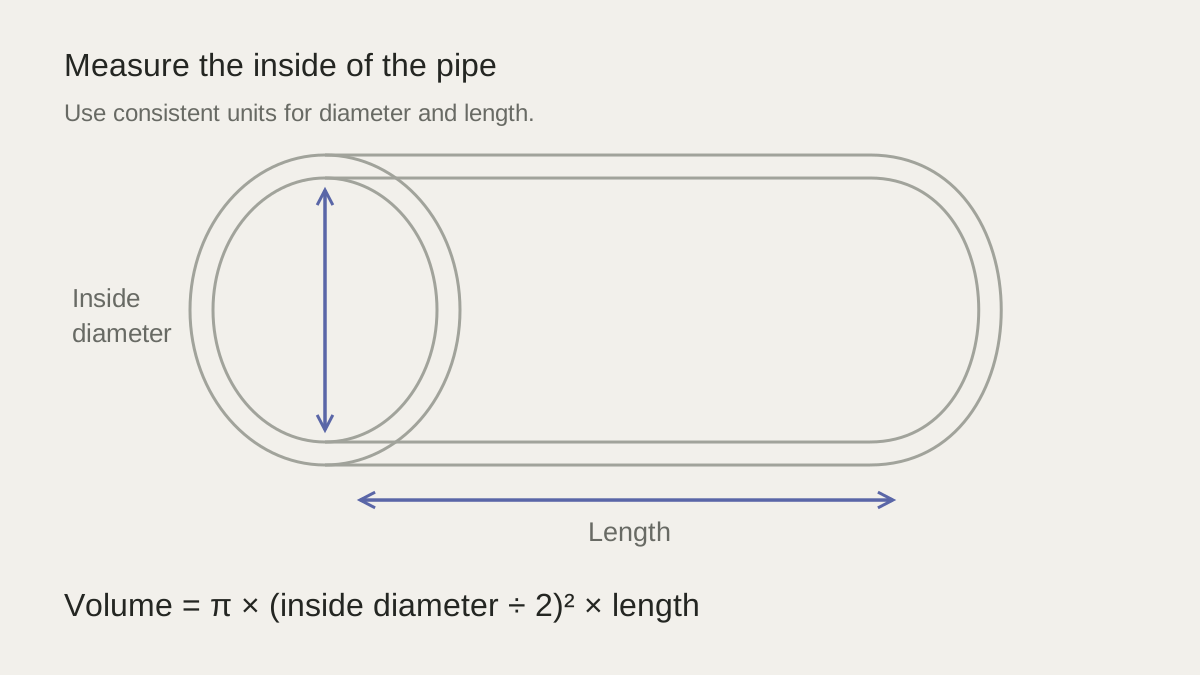
Sketch the route and identify each section by material, product specification and nominal size. Record the actual inside diameter separately when you need a water-volume or velocity calculation. A nominal size is a product name; it is not a promise that the inside opening has that diameter.
Use developed centerline length for pipe volume and material quantity. Use horizontal run for drain-fall geometry. Those lengths answer different questions: the first follows the pipe, while the second is its horizontal projection. Record fittings and equipment independently; a straight-cylinder calculation does not include their internal volumes.
A worked example with two different questions
Suppose a survey identifies 100 ft of straight pipe with an actual 1.000-inch inside diameter. Its full internal volume is π × (0.5 in)² × 1,200 in = approximately 942.48 in³. Divide by 231 in³ per US gallon: the pipe holds about 4.080 US gallons, or 15.444 liters. This is an illustrative diameter, not a dimensional claim about a nominal-size product.
Now consider a separate 20 ft horizontal drain run at a designer-selected slope of 0.25 in/ft. The fall is 20 × 0.25 = 5 in. The slope is 0.25 ÷ 12 × 100 = 2.0833%. Calling that slope exactly 2% would yield a different fall: 4.8 in over the same run. These are geometric examples, not permitted-slope recommendations.
Neither result tells you the number of elbows, couplings, transitions, hangers or access points. Those come from the actual route and the specified installation. Likewise, a water-volume answer does not establish flow capacity or the pressure remaining at a fixture.
Turn the route into a purchase list
List pipe by product and stock length, then plan cuts. Ten 10 ft lengths provide 100 ft of stock in this example; that arithmetic does not include joint insertion, cut losses or mistakes. Add a deliberate allowance based on the cut plan and supplier packaging instead of applying an unexplained percentage to every item.
Count fittings, valves and supports from the sketch. Add adapters, consumables and any testing or protection materials the specification requires. Record supplier unit cost and package quantity separately. A ten-pack price used as a per-fitting cost can overwhelm an otherwise careful estimate.
Check what is already available before ordering. Relay’s free truck inventory app can keep a local parts list, counts and restock targets, with CSV export and backups. It does not reserve project stock or synchronize a team’s trucks. Use the existing reorder calculator for a replenishment worksheet rather than mistaking a project purchase list for a standing truck-stock target.
Price the complete scope, then explain it to the customer
Add labor, access, isolation, removal, protection, testing and disposal where the job requires them. Use current supplier costs for materials. Relay’s flat-rate calculator combines labor and overhead per billable hour with materials at your selected margin. Avoid counting a trip charge twice if drive time is already included.
Transfer the finished price into the existing estimate builder. Describe the route, material, endpoints and restoration included. Identify exclusions and unresolved conditions, such as concealed damage or access that has not been inspected. Only offer Good, Better, Best packages when each option represents a real scope difference; do not invent three versions of the same required repair.
Attach or retain the calculation report with the job assumptions. A customer can then distinguish a measured quantity from an allowance. If the route changes, revise the quantities and price before asking for approval rather than treating an earlier worksheet as authority for extra work.