CFM, air changes and duct velocity: a worked field worksheet
Worked methods and examples from Relay. References checked November 13, 2026.
Airflow, air changes and duct velocity answer different questions. Airflow is volume per unit time. Air changes compare a flow with room volume. Duct velocity compares a flow with duct area. A useful field report keeps the measurement basis with each result so a customer or colleague can understand what was actually checked.
Record what the airflow measurement represents
Write down the instrument, measurement location, operating mode and whether the number is total supply, outdoor air, exhaust or equivalent clean airflow. Record room dimensions and the clear inside duct dimensions, accounting for internal lining. Do not label total recirculating supply as fresh air.
A flow hood or a properly performed traverse can support an airflow measurement. One centerline velocity reading generally does not represent the cross-sectional average. The TSI / Alnor HVAC handbook explains instrument and traverse considerations. These worksheets do not correct an unreliable measurement.
Work from measured flow to air changes
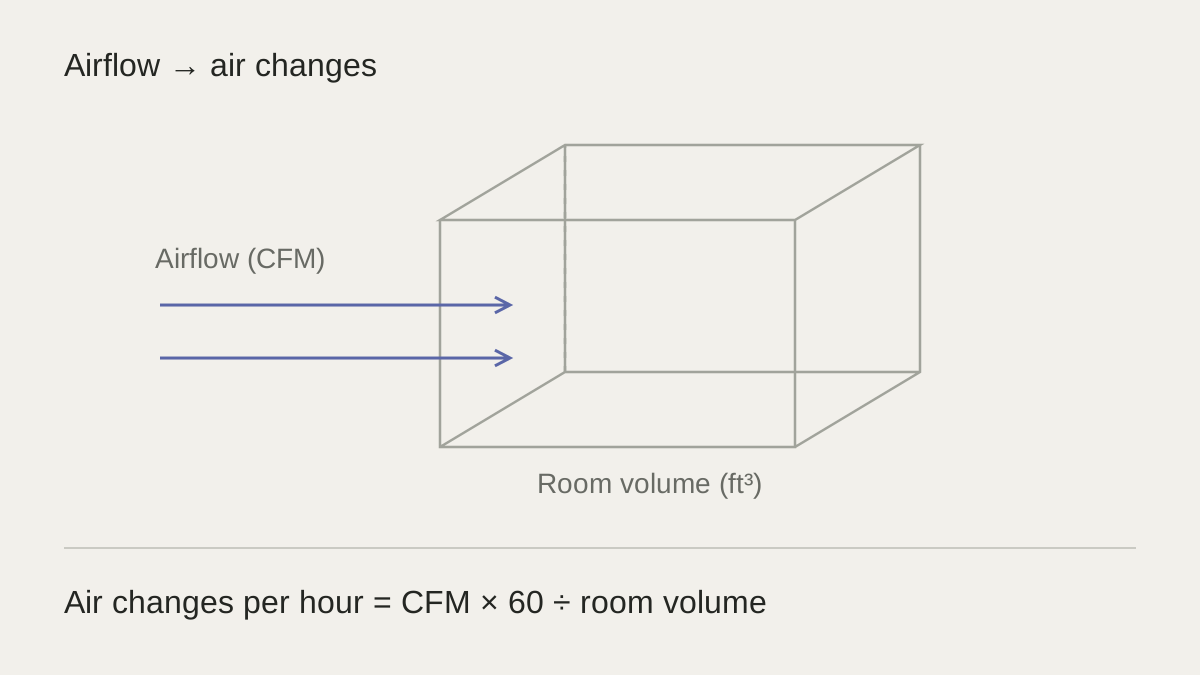
A 12 × 10 × 10 ft room contains 1,200 ft³. At 80 CFM, one hour moves 4,800 ft³, so the calculated rate is 4 ACH. This follows the CDC / NIOSH air-change method. It describes a volume-flow ratio; it does not prove all room air is uniformly replaced four times.
For a chosen 6 ACH target, the same room requires 120 CFM on the chosen airflow basis. The CFM / ACH worksheet solves either direction. It does not choose the target or decide whether a space meets a ventilation standard. Do not add supply and exhaust as though each independently supplies clean air.
Calculate duct velocity from inside area
A 12-inch inside-diameter round duct has about 0.7854 ft² of area. A 400 CFM flow divided by that area gives about 509 ft/min. A 12 × 8-inch rectangular duct has 0.6667 ft² of clear area, so the same flow gives 600 ft/min.
The duct-velocity worksheet reproduces both examples. Neither answer establishes that the duct is suitable. Friction, fittings, external static pressure, flex compression, noise and fan performance still matter. Full duct-system design requires an appropriate procedure such as Manual D where applicable.
Make the field result reusable
Download the calculation report with the measurements, units, method and limits. Keep the report with the inspection record. If corrective work is justified by the diagnosis, price the actual scope and carry that price into the estimate builder. A calculated air-change rate alone is not a reason to recommend equipment replacement.