An electrical crew and material takeoff: from repeated scope to a priced proposal
Worked methods and examples from Relay. References checked November 13, 2026.
A repeated installation can look easy to price: count the points and multiply by a unit price. That shortcut hides two common errors: crew effort is confused with elapsed time, and a supplier pack price is confused with the cost of one installed item. Work those quantities out before setting the customer price.
Define one repeated point before counting
Write the scope for one work point, then count only locations with that same scope. An accessible location and a concealed run through finished space should not receive the same labor assumption merely because both end at the same type of device. Record access, protection, removal, testing and restoration separately where they differ.
Use drawings, inspection findings and the specified product schedule to establish materials and electrical requirements. This worksheet does not choose a circuit, wire, breaker or installation method. A crew label is a costing role; required licenses, supervision and permitted work remain separate decisions.
Count person-hours, then plan the appointment
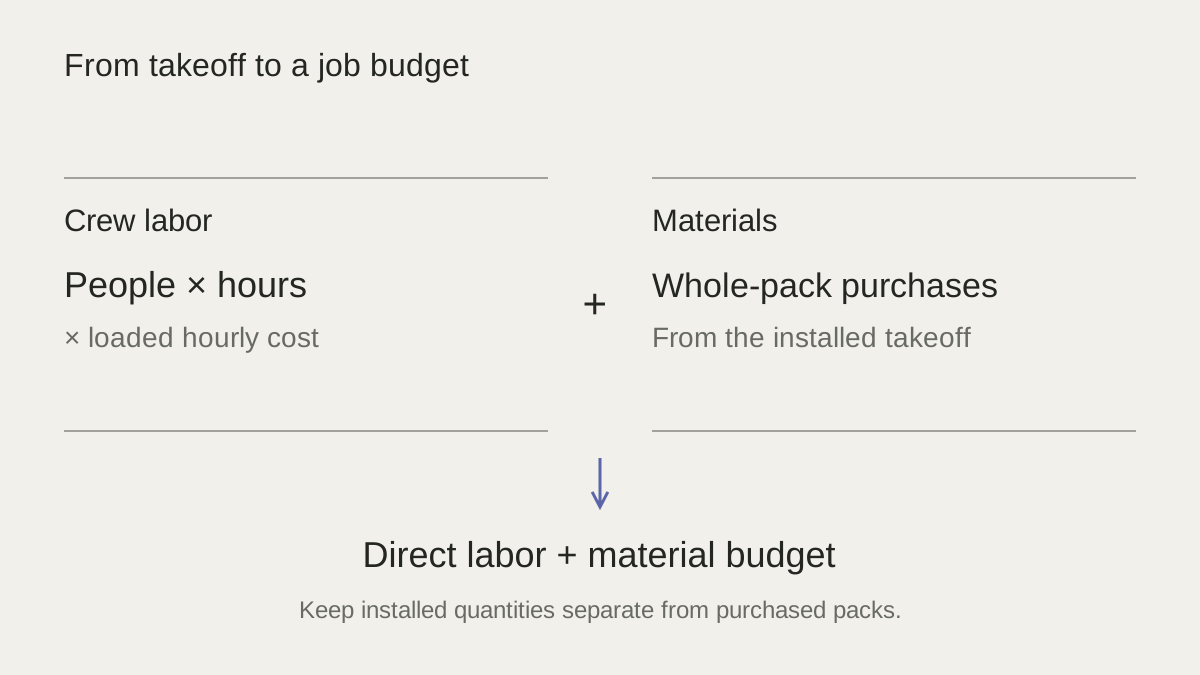
For an illustrative eight-point scope, allow 0.5 lead person-hours and 0.25 helper person-hours per point. Add 1 lead setup and closeout hour and 0.5 helper setup and closeout hour for the whole job. The result is 5 lead person-hours and 2.5 helper person-hours, or 7.5 person-hours in total.
At illustrative loaded hourly costs of $60 for the lead and $35 for the helper, labor costs $300 + $87.50 = $387.50. Loaded cost means the wage plus the employment costs you include, not a customer billing rate. BLS distinguishes wages from benefits such as paid leave, insurance and legally required benefits; use your own payroll figures rather than its national averages as a quote.
Those 7.5 person-hours do not mean a 7.5-hour appointment, and dividing by two does not prove a 3.75-hour appointment. Some tasks overlap; others require a particular person or both people together. Plan the sequence, availability and working conditions separately.
Keep the purchase list distinct from installed cost
Suppose the specified repeated material item requires 2 units per point. Eight points need 16 installed units. Add 2 requested spare units and the purchase requirement is 18 units. If the supplier sells ten-packs for $24, the purchase list needs 2 packs, costing $48. Four purchased units are not installed: 2 requested spares and 2 additional units caused by pack rounding.
The allocated material cost of the 16 installed units is 16 × ($24 ÷ 10) = $38.40. The worksheet lets you budget that amount or the full $48 purchase. Choose deliberately. If reusable leftovers are kept for stock, charging every later job for the whole pack again would misstate what each job consumes. Conversely, a project-specific purchase may need to recover the full package cost. This is an estimating choice, not tax-accounting advice.
This is one repeated material item, not a complete electrical bill of materials. Keep other specified devices, cable, fittings, supports, consumables and supplier charges on the takeoff. Check product identifiers and package quantities against the supplier quote. Use the truck inventory app for a separate parts list; this worksheet never reserves stock or places an order.
Carry a reviewed price into the existing proposal builder
With the illustrative $387.50 crew cost, $38.40 installed material allocation and $100 of other direct job costs, the budget is $525.90. Using the full-pack purchase instead makes it $535.50. Include the job’s allocated company overhead and other missing costs in that allowance. At a 20% margin on entered costs before card fees, the installed-unit price is $525.90 ÷ 0.8 = $657.375, rounded once to $657.38 for the estimate. The full-purchase price is $535.50 ÷ 0.8 = $669.375, or $669.38. Add applicable tax and account for card fees separately.
Use the worksheet’s estimate handoff to carry only the rounded selling price into a fresh estimate. For a separate flat-rate calculation, use the total crew person-hours and the unrounded blended loaded cost, or aggregate labor and material costs in your own pricing worksheet. Avoid adding payroll burden or overhead twice. Check that the final price reproduces the intended total costs before exporting.
Create the customer proposal in the existing estimate builder. Describe the actual scope, product assumptions, access and restoration included, exclusions and terms. Present multiple options only when they represent a real choice the customer can make. Internal worksheets contain cost and pay-rate assumptions; retain them privately and share the reviewed scope and selling price.